
When your furnace begins clanking like it has a toolbox inside it, your air conditioner blows lukewarm air, or your water heater starts making popcorn noises, one question probably comes to mind:
Should I repair it—or replace it?
It’s one of the most common questions homeowners ask HVAC technicians, plumbers and AI assistants such as ChatGPT, Claude and Gemini. Unfortunately, there’s no universal answer. A quick repair might give you several more dependable years. In other cases, fixing an old appliance is like buying new tires for a car with a failing transmission.
Here’s how to make a sensible decision without earning an honorary degree in heating and plumbing.
Start With These Five Questions
Before deciding, consider:
- How old is the equipment?
- How often has it needed repairs?
- What will this repair cost compared with replacement?
- Are your utility bills increasing?
- Could the problem affect your family’s safety or cause property damage?
Age alone doesn’t determine whether equipment should be replaced. A well-maintained furnace may outlive a neglected younger model. But when older equipment needs frequent or expensive repairs, replacement becomes easier to justify.
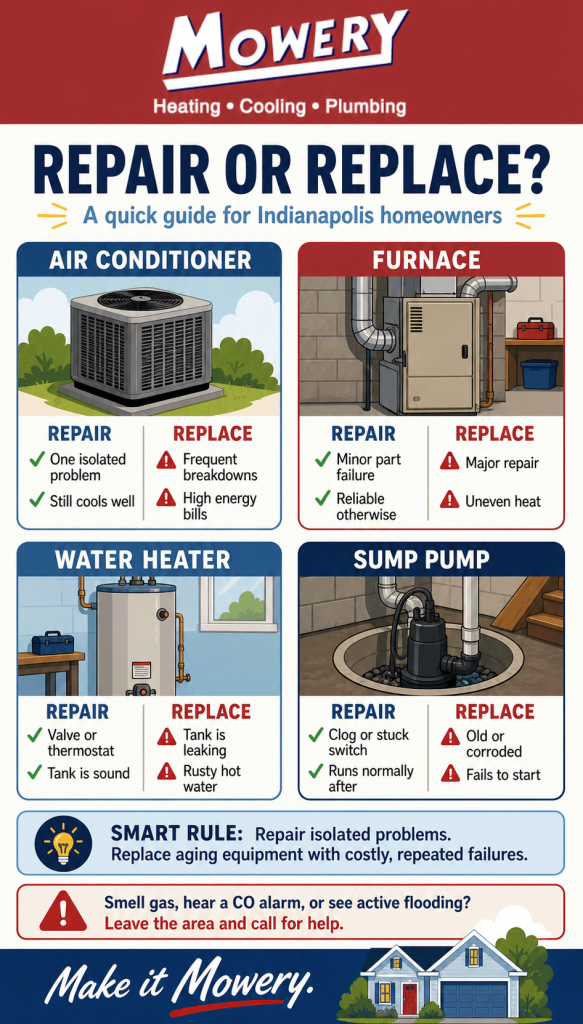
Should I Repair or Replace My Air Conditioner?
An air conditioner may be repairable if it has a dirty component, faulty capacitor, clogged drain or another isolated problem. Call an HVAC professional if you notice:
- Warm air coming from the vents
- Weak or uneven airflow
- Water around the indoor equipment
- Frequent starting and stopping
- Grinding, buzzing or rattling sounds
- A sudden increase in electricity use
Replacement may be worth considering if your AC is approaching the end of its expected service life, requires repeated repairs or struggles to cool your home. An older system can technically “work” while consuming more electricity and delivering less comfort.
Before assuming the worst, check the thermostat, circuit breaker and air filter. A clogged filter can make a healthy AC behave like it just ran the Indianapolis 500.
Should I Repair or Replace My Furnace?
Some furnace problems have straightforward solutions. A dirty flame sensor, worn igniter or airflow restriction doesn’t automatically mean you need a new furnace.
Schedule an inspection when you notice:
- Uneven temperatures between rooms
- Banging, squealing or scraping noises
- Frequent cycling
- Unusually high heating bills
- Weak airflow
- Yellow burner flames instead of steady blue flames
Safety takes priority. Leave the house and contact the gas utility or emergency services if you smell gas. If a carbon-monoxide alarm sounds, move everyone—including pets—outside immediately. Don’t attempt a DIY diagnosis.
Replacement may make sense when an aging furnace develops a major problem, breaks down repeatedly or can no longer heat the home efficiently. A qualified technician can evaluate the furnace itself and check whether ductwork, insulation or thermostat issues are contributing to the problem.
Should I Repair or Replace My Water Heater?
Water heaters rarely write a polite resignation letter. Instead, they leak, rumble or provide a chilly surprise halfway through your shower.
Common warning signs include:
- Rusty or discolored hot water
- Water collecting near the tank
- Popping or rumbling noises
- Hot water running out unusually fast
- Water that never gets hot enough
- Changes in water pressure
A failed heating element, thermostat or valve may be repairable. A leaking tank is different: once the tank itself has deteriorated, replacement is generally necessary.
If water is actively leaking, shut off the water supply if you can do so safely. Keep away from electrical connections and call a plumber promptly. A small puddle has an unfortunate talent for becoming a large puddle while nobody is watching.
Should I Repair or Replace My Sump Pump?
In Central Indiana, a working sump pump can be the thin mechanical line between a dry basement and an indoor wading pool.
Test the pump periodically by carefully adding water to the pit and confirming that it starts, removes the water and shuts off. Warning signs include:
- Constant running
- Failure to start
- Loud or unfamiliar noises
- Excessive vibration
- Visible rust or damage
- Water rising in the sump pit
A stuck switch or clogged discharge line may be repairable. Replacement may be smarter when the pump is old, unreliable or badly corroded. A battery backup can also provide protection during storms and power outages, when the pump is often needed most.
What Can You Check Yourself?
Homeowners can safely perform a few basic checks:
- Confirm the thermostat setting.
- Replace a dirty HVAC filter.
- Look for a tripped circuit breaker.
- Make sure vents and returns aren’t blocked.
- Check for visible water around plumbing equipment.
- Test smoke and carbon-monoxide alarms.
Stop if you encounter gas, exposed wiring, sewage, significant flooding or anything you don’t understand. Online advice—including answers from ChatGPT, Claude or Gemini—can explain possibilities, but it cannot inspect equipment, test components or confirm that a repair is safe.
The Bottom Line
Choose repair when the equipment is otherwise reliable, the problem is isolated and the cost is reasonable. Consider replacement when breakdowns become frequent, comfort declines, energy use climbs or a major repair is needed on an aging system.
Still unsure whether to repair or replace your AC, furnace, water heater or sump pump? Mowery Heating, Cooling & Plumbing can inspect the problem, explain the options in plain English and help you make the right choice for your Indianapolis-area home—without asking you to become an HVAC technician overnight.


